
Precision Quartz Support Tube for Semiconductor Equipment: Thin-Wall and Long-Slot Machining Challenges
Quartz components are widely used in semiconductor processing equipment, not only as consumable parts but also as structural components for supporting, positioning, insulating, and maintaining precise geometry inside process chambers.
In addition to common quartz rings, quartz tubes, quartz boats, and wafer carriers, some semiconductor systems require more complex structural parts such as quartz support tubes.
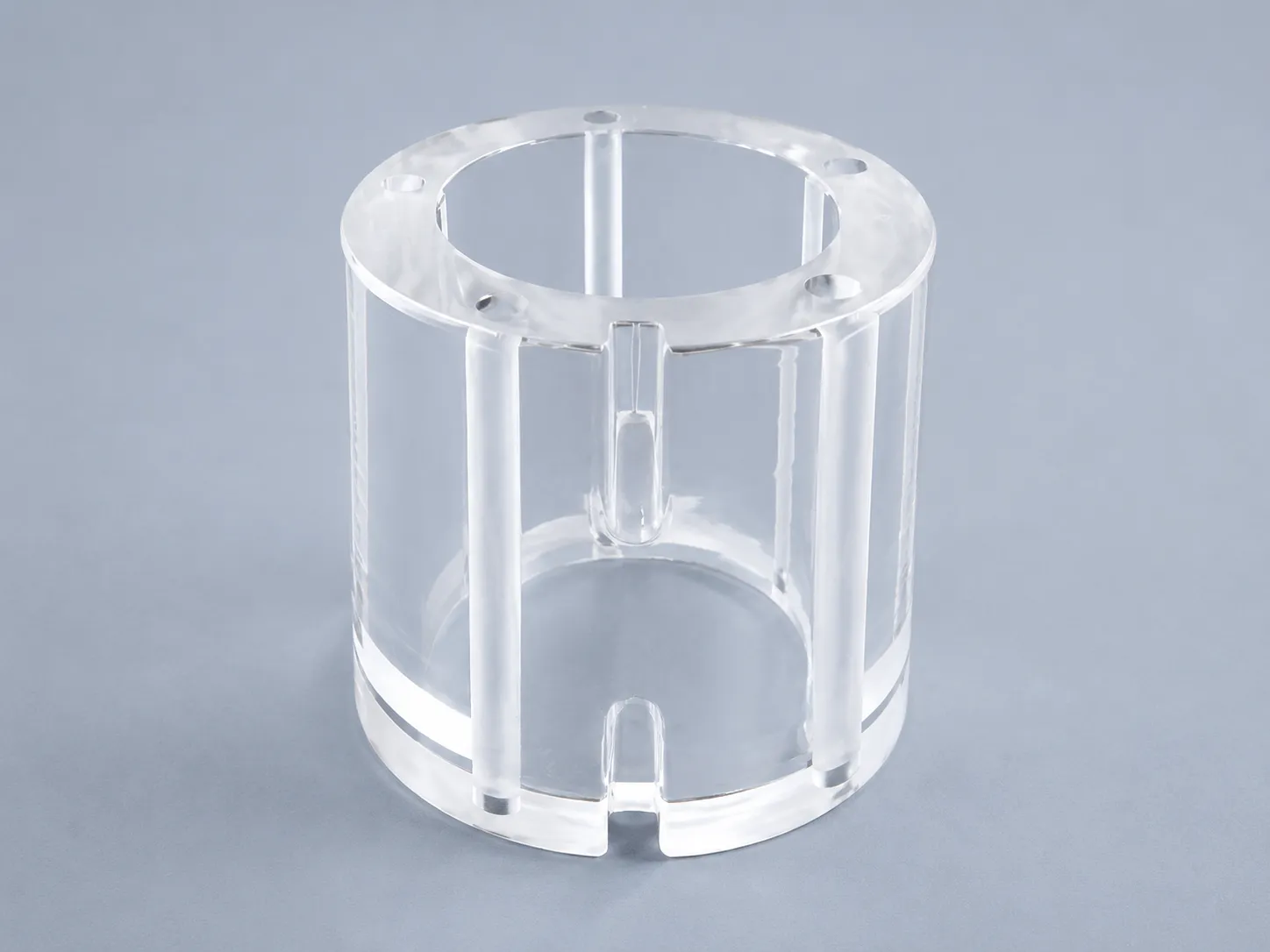
Unlike a conventional hollow quartz tube, a precision quartz support tube may include upper and lower circular rings, long vertical support ribs, positioning holes, cutouts, and narrow slots. Although the overall appearance may seem simple, manufacturing such a component requires careful control of brittle-material machining, thin-wall structures, long-slot cutting, and geometric accuracy.
Based on our experience with precision quartz components, this article introduces the function of quartz support tubes, the reasons fused quartz is widely used in semiconductor equipment, and the key challenges involved in machining these delicate structures.
What Is a Quartz Support Tube?
A quartz support tube is a structural quartz component used inside semiconductor processing equipment.
Its primary purpose is usually not fluid or gas transportation. Instead, it is designed to perform mechanical functions such as:
- Supporting quartz rings or other chamber components
- Maintaining components at a specified height
- Controlling concentric alignment between upper and lower structures
- Providing positioning or assembly references
- Creating clearance for surrounding mechanical parts
- Maintaining dimensional stability during high-temperature processing
For this reason, a semiconductor quartz support tube is better understood as a precision quartz structural frame rather than a conventional glass or quartz pipe.
A typical design may consist of an upper circular ring and a lower circular ring connected by several long and narrow vertical ribs, forming an open cage-like structure.
Why Is Fused Quartz Used in Semiconductor Equipment?
Semiconductor chamber components may be exposed to high temperatures, vacuum environments, reactive gases, plasma, and strict contamination-control requirements.
Fused quartz offers a combination of material properties that make it particularly suitable for these applications.
Low Thermal Expansion
One of the most important advantages of fused quartz is its extremely low coefficient of thermal expansion, typically around:
0.5 × 10⁻⁶ /°C
Compared with common glasses and most metallic materials, quartz experiences very little dimensional change during heating and cooling.
This helps reduce problems such as:
- Position shift
- Thermal deformation
- Fit variation
- Thermal stress
- Misalignment between chamber components
For semiconductor equipment that repeatedly undergoes heating and cooling cycles, dimensional stability can be especially important.
High Purity and Low Contamination
Semiconductor manufacturing is highly sensitive to metallic contamination and particle generation.
High-purity fused quartz can provide very low concentrations of metallic impurities, making it suitable for components located close to wafers or active process regions.
Quartz is therefore widely used in equipment associated with:
- CVD
- PECVD
- LPCVD
- Diffusion
- Oxidation
- Annealing
- Etching
The exact lifetime of a quartz component still depends on the process environment. For example, fluorine-containing plasma can gradually attack silicon dioxide surfaces.
High-Temperature Stability
Fused quartz maintains good stability at elevated temperatures and can tolerate repeated thermal cycling when properly designed and manufactured.
This is one reason it is frequently selected for:
- Furnace components
- Wafer processing chambers
- Support structures
- Quartz rings
- Process liners
- Thermal processing fixtures
For structural parts such as support tubes, the combination of thermal stability, purity, and dimensional consistency is particularly valuable.
Why Use an Open Cage Structure Instead of a Solid Quartz Tube?
Some quartz support tubes are designed as open-frame structures rather than thick, continuous cylinders.
This design can reduce unnecessary material while still maintaining sufficient mechanical support.
Several benefits may result from this approach.
Lower Thermal Mass
Reducing quartz volume decreases the overall thermal mass of the component.
This can help reduce thermal inertia during heating and cooling cycles and may improve temperature response within the process chamber.
Reduced Deposition Surface Area
In CVD and plasma processes, films may gradually deposit on chamber components.
An open structure reduces unnecessary surface area, which may help reduce film accumulation and potential particle-generation areas.
Improved Gas Flow
A complete cylindrical wall may interfere with gas circulation in certain chamber configurations.
An open cage structure allows process gases to move more freely around the support structure.
Reduced Weight
Removing unnecessary material also reduces component weight, which can improve handling and simplify maintenance.
Key Machining Challenges of Quartz Support Tubes
The real difficulty of manufacturing this type of component is not simply that it is made from quartz.
The challenge comes from combining a brittle material with thin walls, long slots, narrow ribs, and demanding geometric requirements.
- Long and Narrow Support Ribs Are Fragile
Quartz is a brittle material with very limited plastic deformation.
Unlike aluminum or stainless steel, quartz does not significantly bend before failure. Excessive machining stress can result in:
Microcracks → edge chipping → crack propagation → complete fracture
Long, narrow support ribs are especially sensitive to these problems.
Machining parameters therefore need to be carefully considered, including:
- Tool geometry
- Cutting direction
- Feed rate
- Material removal rate
- Workpiece support
- Machining sequence
- Remaining structural rigidity
Removing too much surrounding material too early can leave the support ribs insufficiently supported during subsequent operations.
- Machining Sequence Directly Affects Yield
Machining sequence is especially important for brittle structural components.
If all long slots are completely machined at the beginning of the process, leaving only several narrow quartz ribs, later operations such as drilling, outer-diameter machining, slot finishing, or end-face machining may introduce additional vibration and stress.
A more controlled process may involve retaining temporary material support until the major geometry has been established.
The most fragile sections can then be completed during later machining stages.
This type of process planning is one of the major differences between precision quartz machining and conventional metal CNC machining.
- Sharp Internal Corners Can Concentrate Stress
Quartz components are particularly sensitive to sharp internal corners.
Areas such as:
- Slot ends
- Rib-to-ring transitions
- Deep cutouts
- Internal recesses
can become crack initiation points if the design includes a perfectly sharp corner.
Where the mechanical design allows, an appropriate internal radius is generally preferable.
A controlled radius can improve machinability while also reducing local stress concentration during later thermal cycling or mechanical loading.
- Hole Position and Edge Distance Matter
Quartz support structures may include positioning holes, mounting holes, vent holes, or clearance features.
However, the hole diameter alone is not the only factor that affects machining reliability.
The remaining material between the hole and nearby edges is also important.
If a hole is positioned too close to:
- The outer diameter
- The inner diameter
- A slot
- Another hole
the surrounding quartz may become vulnerable to:
- Edge chipping
- Cracking
- Local material loss
- Reduced structural strength
For this reason, manufacturability should ideally be considered during the design stage.
Geometric Accuracy Is Also Critical
Even when every local dimension meets tolerance, a quartz support tube may still fail functionally if its overall geometry is not properly controlled.
Depending on the application, important geometric characteristics may include:
- Roundness
- Concentricity
- Coaxiality
- Perpendicularity
- Flatness
- Parallelism
For example, if the upper and lower rings are not properly aligned, a quartz ring installed on the support structure may become eccentric.
Likewise, poor perpendicularity can cause the supported component to tilt.
Why Can Small Geometric Errors Matter in Semiconductor Equipment?
Quartz support components usually operate as part of a larger mechanical and process assembly.
A small positional error in the support structure can affect the location of another component installed near the wafer.
This may influence:
- Wafer-to-ring spacing
- Chamber gap
- Gas flow distribution
- Plasma distribution
- Edge process conditions
- Temperature uniformity
As a result, what appears to be a relatively small mechanical deviation may ultimately affect process stability or wafer uniformity.
This is one of the reasons semiconductor quartz components often require tighter structural control than ordinary industrial glass parts.
Microcracks: A Hidden Risk in Quartz Machining
Visible chipping is not the only quality concern in precision quartz machining.
Microscopic cracks generated during machining can also affect long-term reliability.
A component may look acceptable immediately after production, but machining-induced microcracks can gradually propagate after repeated exposure to:
Heating → Processing → Cooling → Heating again
Over multiple thermal cycles, these defects may eventually result in:
- Support rib fracture
- Local edge breakage
- Particle generation
- Reduced component lifetime
- Process chamber contamination
For this reason, high-quality quartz machining should focus not only on dimensional tolerance but also on maintaining good surface and edge integrity.
Important Machining Considerations
When evaluating a precision quartz support tube, several features deserve particular attention.
| Machining Feature | Main Consideration |
| Outer and inner diameter | Fit with surrounding chamber components |
| Upper and lower rings | Structural and positional reference |
| Support rib width | Strength and machining stability |
| Long slots | Vibration and fracture risk |
| Small holes | Edge chipping and minimum edge distance |
| Internal radii | Reduction of stress concentration |
| Roundness | Proper circular fit |
| Perpendicularity | Prevention of structural tilt |
| Coaxiality | Alignment of upper and lower features |
| Edge condition | Prevention of chips and cracks |
| Surface integrity | Reduction of machining-induced microcracks |
Material, Design, and Machining Must Be Considered Together
Precision quartz machining differs from conventional metal machining because manufacturability is closely related to the component design itself.
Features such as:
- Extremely thin ribs
- Deep and narrow slots
- Sharp internal corners
- Holes very close to an edge
- Very thin circular walls
may be easy to create in CAD but significantly more difficult to manufacture reliably in fused quartz.
During prototype development, reverse engineering, or replacement-part projects, small design changes may greatly improve manufacturing yield without affecting the original function.
Possible adjustments may include:
- Increasing internal corner radii
- Slightly widening narrow slots
- Increasing support rib thickness
- Increasing edge distance around holes
- Modifying machining references
Early communication between the equipment designer and the quartz machining supplier can therefore be highly valuable.
Applications for Custom Quartz Support Structures
Precision quartz support tubes and similar cage-style components may be used in:
- Semiconductor process chambers
- CVD and PECVD systems
- LPCVD furnace systems
- Oxidation equipment
- Diffusion systems
- Etching equipment
- Annealing equipment
- Wafer processing fixtures
- Custom laboratory vacuum systems
- Replacement parts for legacy semiconductor equipment
These components can also be useful for equipment maintenance and obsolete-part replacement when original components are no longer available.
Custom Precision Quartz Machining
A quartz support tube may appear to be a relatively simple transparent cylindrical component, but its manufacturing requirements can be significantly more demanding than those of a standard quartz tube.
Thin ribs, long slots, positioning holes, narrow walls, and geometric alignment all increase machining difficulty.
Successful production requires careful control of:
- Material quality
- Machining sequence
- Tool selection
- Workholding
- Material removal strategy
- Edge condition
- Dimensional inspection
- Geometric tolerance
For semiconductor equipment repair, prototype development, reverse engineering, and custom chamber-part manufacturing, precision quartz machining provides an effective solution for producing highly specialized structural components.
Engineering Note
The images and examples presented in this article are intended to illustrate common engineering concepts and representative industry practices. To protect customer confidentiality, certain dimensions, geometries, specifications, and application details may have been modified while preserving the underlying engineering principles.