

Custom Quartz Gas Injector for Semiconductor Equipment – Precision Angled Hole Machining Case Study
In semiconductor process equipment, the way process gases are introduced into a chamber can directly affect gas distribution, reaction uniformity, and overall process stability. In addition to large showerheads and gas distribution plates, many systems also use compact gas injectors, gas nozzles, and custom gas distribution components to deliver process gases to specific areas inside the equipment.
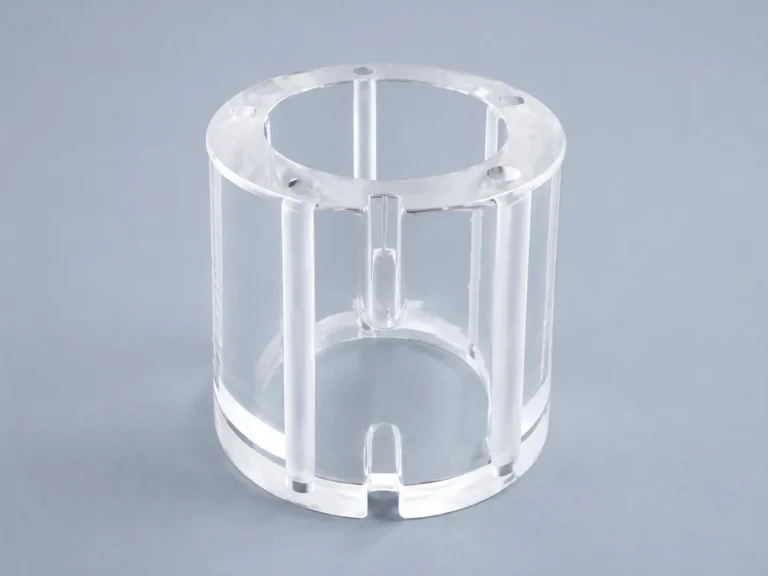
In one of our quartz machining projects, we worked with a compact high-purity quartz gas distribution component featuring an internal flow cavity and multiple angled holes around the cylindrical body. Although the part appears relatively simple from the outside, its manufacturing difficulty lies in controlling the angle, position, diameter, and internal breakthrough quality of each gas hole.
This type of component demonstrates an important difference between precision quartz machining and conventional glass fabrication: the most critical features are often hidden inside the part.
What Is a Quartz Gas Injector?
A quartz gas injector is a component used to introduce and distribute process gases inside semiconductor or other high-temperature process equipment.
Depending on the equipment design, a gas injector may be a simple tube with outlet holes, or it may incorporate a more complex geometry including internal cavities, closed ends, multiple flow channels, circumferential gas holes, and angled outlets.
Quartz gas injectors and similar gas distribution components may be used in equipment associated with CVD, PECVD, plasma etching, diffusion, oxidation, high-temperature processing, vacuum processing, and other semiconductor manufacturing operations.
The exact function and geometry vary considerably from one system to another. For this reason, these parts are generally manufactured as custom quartz components according to the original equipment design or customer drawing.
Why Is Quartz Used in Semiconductor Gas Delivery Components?
Quartz, particularly high-purity fused quartz or fused silica, is widely used in semiconductor equipment because of its combination of thermal stability, chemical resistance, electrical insulation, and low contamination potential.
One of the most important considerations in semiconductor processing is contamination control. Even very small concentrations of metallic contaminants such as iron, nickel, or chromium may negatively affect sensitive wafer processes.
For components located near the process chamber or gas delivery path, high-purity quartz can therefore provide significant advantages over conventional metallic materials.
Quartz also has a very low coefficient of thermal expansion and maintains good dimensional stability under elevated-temperature conditions. This makes it suitable for applications involving repeated heating and cooling cycles.
Its chemical resistance also allows quartz to be used in many process environments where conventional materials may be susceptible to corrosion or unwanted reactions.
Another advantage is electrical insulation. In certain plasma or electrically active environments, the non-conductive nature of quartz can be an important functional requirement.
For semiconductor equipment, quartz is therefore selected not simply because it is transparent, but because it provides a useful combination of purity, thermal performance, chemical compatibility, and electrical properties.
Case Study Design: Internal Gas Channel with Multiple Angled Holes
The quartz component in this case features an internal cavity that acts as a gas flow channel.
Process gas can enter the internal cavity through the main inlet before being distributed through several small holes positioned around the cylindrical section of the component.
The distinctive feature is that these outlet holes are not simple radial holes.
Instead, they are machined at specific angles.
This means that the critical dimensions are not limited to hole diameter. The machining process must also control the position of each hole, drilling angle, penetration depth, circumferential spacing, and the point at which the angled hole intersects the internal gas cavity.
As a result, even a relatively small quartz component can involve considerable manufacturing complexity.
Why Are Angled Gas Holes Used?
If the only purpose were to allow gas to escape from the internal cavity, straight radial holes would generally be easier to manufacture.
However, semiconductor gas delivery systems may intentionally use angled holes to control the direction of the outgoing gas flow.
An angled outlet changes the velocity direction of the gas as it exits the injector. Depending on the complete chamber design, this may help guide process gas toward a specific area, increase gas dispersion, improve mixing between gases, or reduce direct gas impingement on a sensitive surface.
When several angled holes are distributed around the circumference of a component, the geometry can also be used to create a directional or partially tangential flow pattern.
In certain designs, this may contribute to rotational or circulating gas flow.
However, angled holes alone do not necessarily mean that a component is a swirl nozzle. The actual gas-flow behavior depends on hole angle, orientation, diameter, number of outlets, gas flow rate, chamber pressure, and the surrounding equipment geometry.
The purpose of the hole pattern must therefore be evaluated according to the actual drawing and process design.
Why Is Angled Hole Machining in Quartz Difficult?
If the same geometry were manufactured from aluminum or stainless steel, angled drilling would already require careful setup.
With quartz, the challenge becomes significantly greater.
Quartz is a hard and brittle material. Unlike ductile metals, it has very limited ability to plastically deform during machining.
When localized machining stress becomes excessive, the material tends to fracture rather than deform.
This can result in chipping, microcracks, edge damage, or, in more severe cases, complete part failure.
For this reason, quartz machining requires a very different machining strategy from conventional metal CNC machining.
Controlling Chipping at the Angled Hole Entrance
The entrance of an angled hole is one of the most critical areas.
During conventional perpendicular drilling, the cutting tool initially contacts the workpiece relatively symmetrically.
With an angled hole, the tool initially contacts only one side of the quartz surface.
This produces an uneven cutting load during the initial stage of machining.
If tooling, feed rate, rotational speed, support conditions, or machining sequence are not properly controlled, localized stress may cause significant chipping around the hole entrance.
For semiconductor quartz components where cleanliness and structural integrity are important, the condition of the hole entrance must therefore be carefully controlled.
The Internal Breakthrough Is Often More Difficult Than the Visible Hole Entrance
Another major challenge occurs when the angled hole reaches the internal gas cavity.
As the tool approaches the internal wall, the remaining quartz material becomes increasingly thin.
When breakthrough occurs, the material surrounding the exit point suddenly loses support.
This creates a higher risk of internal chipping, local fracture, or microcrack formation.
Unlike damage at the external hole entrance, internal breakout defects may not be immediately visible from outside the part.
Nevertheless, these defects can be important.
Large chips or cracks may compromise the mechanical integrity of the component, while loose particles can potentially become a contamination source inside semiconductor equipment.
For this reason, the internal intersection between the angled hole and the gas channel is often one of the most important areas to consider during process development.
Maintaining Hole Position and Angular Consistency
When multiple gas holes are distributed around a quartz injector, it is generally important that their positions and orientations remain consistent.
A deviation in one hole may change the direction of gas leaving the component.
Manufacturing therefore involves simultaneous control of several parameters, including hole diameter, hole position, drilling angle, circumferential spacing, and the intersection location between each hole and the internal cavity.
This is why the difficulty of this type of part cannot be evaluated simply by counting the number of drilled holes.
The relationship between all of the three-dimensional features is often much more important than the number of features itself.
How Can a Quartz Gas Injector Be Manufactured?
The most appropriate manufacturing process depends on the overall geometry, quartz grade, hole diameter, hole depth, angular requirements, surface condition, and dimensional tolerances.
Typical manufacturing technologies for precision quartz components may include diamond tool machining, diamond grinding, ultrasonic machining, precision drilling, and, for certain geometries, laser-based processes.
Parts containing external profiles, internal cavities, angled holes, and mounting flanges may require a combination of several processes rather than a single machining operation.
For example, the cylindrical geometry and flange features may be produced through precision grinding or other quartz machining methods, while small angled holes require a dedicated drilling strategy.
Some quartz assemblies may also combine mechanically machined features with quartz tube fabrication, fusion, or flame-processing operations.
The manufacturing sequence must therefore be developed individually according to the drawing.
Cleaning Is an Important Part of Semiconductor Quartz Manufacturing
For semiconductor applications, machining is only one part of the manufacturing process.
Quartz machining can generate fine silica particles, grinding residue, coolant contamination, and other process-related debris.
Depending on the final application, appropriate post-machining cleaning is therefore required.
This becomes especially important for gas injectors because particles may remain trapped inside small holes or internal channels.
If residual particles are not removed, they can potentially become particle contamination after the component is installed inside semiconductor equipment.
For this reason, both dimensional quality and cleanliness should be considered when evaluating a custom semiconductor quartz component.
A Compact Component with Significant Manufacturing Complexity
In this project, the component was manufactured from transparent quartz and incorporated a closed rounded upper section, a lower positioning flange, an internal gas cavity, and several angled outlet holes around the body.
Although the overall part size was relatively small, the primary manufacturing concerns were associated with the angled-hole geometry.
Particular attention was required for hole orientation, entrance chipping, internal breakthrough, and the consistency of multiple holes.
The goal in machining a component like this is not simply to remove material as quickly as possible.
The process must remove material in a controlled manner while minimizing microcracking, edge damage, and internal fracture.
This is one of the key differences between precision quartz machining and conventional CNC machining of metallic parts.
Applications Beyond Quartz Gas Injectors
The same manufacturing principles can also apply to many other custom semiconductor quartz components.
Examples include quartz gas nozzles, gas distribution components, process tubes, diffusion furnace components, chamber components, and specialty quartz parts incorporating intersecting holes or internal channels.
These parts may contain straight holes, angled holes, blind holes, intersecting passages, thin-wall features, or complex three-dimensional gas flow paths.
When evaluating such components, it is therefore important to understand not only the individual dimensions, but also the spatial relationship between the holes, internal cavities, and external geometry.
Conclusion
A quartz gas injector may appear to be a simple small component, but its true manufacturing difficulty can be hidden inside the part.
When internal gas channels, multiple angled holes, and thin-wall regions are combined in a brittle material such as quartz, the machining process must carefully control chipping, microcracking, hole position, drilling angle, and internal breakthrough quality.
For semiconductor applications, dimensional accuracy alone is also not sufficient. Material purity, surface integrity, particle control, and post-machining cleanliness can all be important considerations.
Precision manufacturing of a custom quartz gas injector is therefore much more than simply drilling holes in glass. It is a specialized manufacturing process that combines brittle-material machining, three-dimensional geometric control, and semiconductor cleanliness requirements.
For quartz components incorporating angled holes, small gas passages, internal channels, or other customized geometries, each project should be individually evaluated according to the drawing, material specification, tolerance requirements, and intended process environment.
Engineering Note
The images and examples presented in this article are intended to illustrate common engineering concepts and representative industry practices. To protect customer confidentiality, certain dimensions, geometries, specifications, and application details may have been modified while preserving the underlying engineering principles.