
High Thermal Conductivity AlN Ceramic Heater: From Material Properties to a 230 W/m·K Development Case
As semiconductor manufacturing, power electronics, vacuum equipment, and precision thermal-control technologies continue to advance, materials are increasingly required to provide not only thermal performance, but also electrical insulation, dimensional stability, and reliability under elevated temperatures.
Among advanced engineering ceramics, aluminum nitride (AlN) is particularly attractive because it combines high thermal conductivity with excellent electrical insulation.
These characteristics have made AlN an important material for semiconductor equipment, ceramic heaters, power modules, electronic substrates, high-power devices, and other applications requiring efficient thermal management.
One of its most important applications is the AlN ceramic heater, where heat must be transferred rapidly and uniformly while maintaining electrical isolation.
How High Is the Thermal Conductivity of Aluminum Nitride?
Commercial aluminum nitride is already considered a highly thermally conductive ceramic.
Actual thermal conductivity depends on several factors, including material purity, oxygen content, sintering additives, grain structure, grain-boundary phases, density, and manufacturing conditions.
For commercial high-performance AlN ceramics, approximately 170–180 W/m·K at room temperature is a representative thermal conductivity range. For example, CeramTec specifies approximately 170 W/m·K for one of its AlN substrate materials, while commercial AlN grades with thermal conductivity of 180 W/m·K are also available.
This is significantly higher than conventional alumina (Al₂O₃), which typically has a thermal conductivity of only around 20–30 W/m·K. CeramTec, for example, lists approximately 24 W/m·K for Al₂O₃ compared with 170 W/m·K for AlN.
With further optimization of material composition and sintering conditions, AlN can reach even higher thermal conductivity levels.
Commercial grades are currently available at approximately:
| AlN Thermal Conductivity | General Classification |
| 170–180 W/m·K | Common high-conductivity AlN |
| 200 W/m·K | High thermal conductivity AlN |
| 230 W/m·K | Ultra-high thermal conductivity AlN |
MARUWA, for example, publishes commercial AlN grades with thermal conductivity values of approximately 180, 200, and 230 W/m·K at 25°C.
Achieving the 230 W/m·K level is therefore considerably more demanding than producing conventional high-conductivity AlN.
What Is an AlN Ceramic Heater?
An AlN ceramic heater is a heating component that uses aluminum nitride ceramic as the primary structural and heat-spreading material.
AlN itself is not normally the main heat-generating element. Instead, electrical resistance heating elements are incorporated either within or onto the ceramic structure.
When electrical current passes through the resistive heating element, heat is generated and transferred into the surrounding AlN ceramic. Because of AlN’s high thermal conductivity, this heat can spread rapidly throughout the heater plate.
The basic principle is:
Electrical Energy → Resistive Heating Element → Heat Generation → AlN Heat Spreading → Uniform Heating Surface
Compared with lower-conductivity ceramic materials, AlN can reduce localized temperature gradients and hot spots, making it especially suitable for applications where temperature uniformity is critical.
For high-performance semiconductor applications, heating elements may be co-sintered directly into the AlN ceramic body, creating an integrated ceramic heater structure.
NGK, for example, manufactures AlN ceramic heaters in which resistance heating elements are co-sintered with the ceramic. These heaters are designed to support and heat semiconductor wafers while providing excellent thermal uniformity.
Why Is AlN Used for Semiconductor Ceramic Heaters?
In semiconductor manufacturing processes such as CVD and other deposition processes, wafer temperature has a significant influence on process stability and uniformity.
If different areas of a wafer experience different temperatures, variations may occur in parameters such as:
- Deposition rate
- Film thickness
- Material properties
- Reaction rate
- Process uniformity
For this reason, a semiconductor wafer heater must do much more than simply reach a target temperature.
It must provide stable and uniform thermal distribution across the wafer surface.
AlN is particularly suitable for this purpose because its high thermal conductivity allows heat generated by embedded heater elements to spread efficiently throughout the ceramic plate.
At the same time, AlN provides excellent electrical insulation. Commercial high-conductivity AlN can provide volume resistivity above 10¹³–10¹⁴ Ω·cm while maintaining very high thermal conductivity.
This combination makes AlN particularly valuable for:
- Semiconductor Ceramic Heaters
- Wafer Heaters
- Heated Susceptors
- Vacuum Heating Stages
- Semiconductor Process Chambers
- Power Electronics
- High-Power Thermal Management Components
High-end semiconductor heaters may also integrate additional functions such as RF electrodes or electrostatic chucking within the ceramic structure.
NGK’s semiconductor ceramic heaters, for example, are available for 200 mm, 300 mm, and 450 mm wafers and use AlN together with co-sintered resistance-heating elements.
Case Study: Developing an AlN Heater Plate with 230 W/m·K Thermal Conductivity
For many applications, AlN with a thermal conductivity of approximately 170–180 W/m·K already provides excellent heat-transfer performance.
However, certain high-power, high-heat-flux, or precision temperature-control systems require even greater thermal performance.
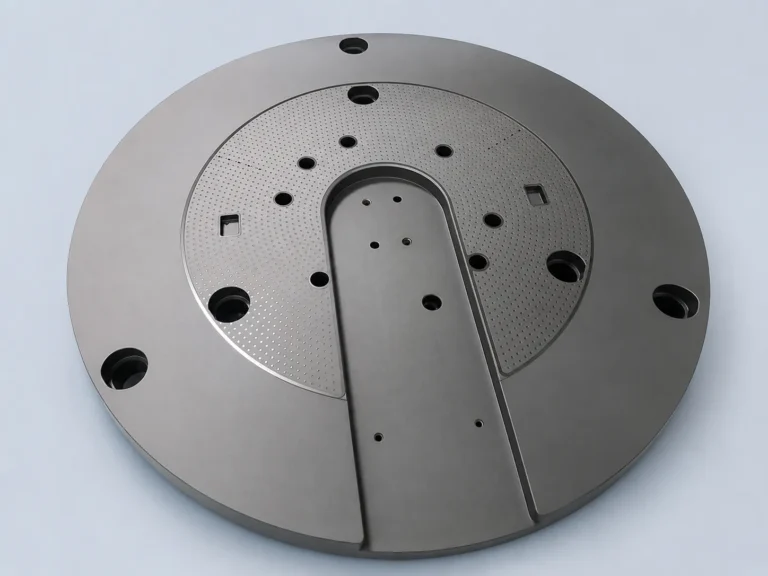
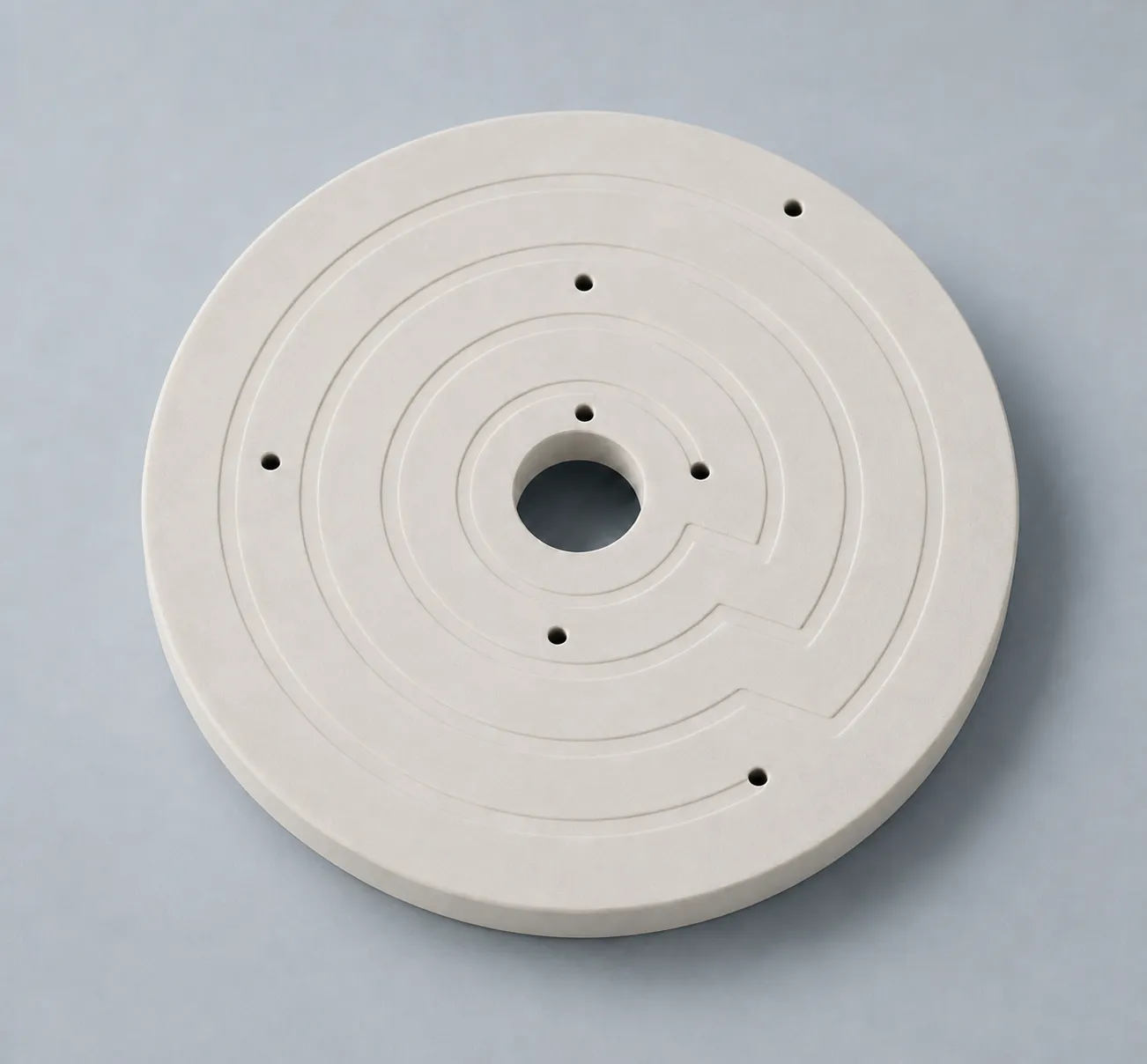
In one of our custom development projects, we supported a customer in developing a high thermal conductivity AlN ceramic heater plate.
The objective was to increase heat-transfer efficiency while retaining the electrical insulation and high-temperature characteristics associated with aluminum nitride ceramic.
Through optimization of the material and manufacturing process, the final AlN heater plate achieved a thermal conductivity of 230 W/m·K.
Compared with conventional high-conductivity AlN in the 170–180 W/m·K range, reaching the 230 W/m·K level provides additional thermal-management advantages, particularly for applications requiring rapid heat spreading and highly uniform temperature distribution.
For a ceramic heater, higher thermal conductivity can contribute to:
- Faster heat transfer
- Reduced local thermal gradients
- Reduced hot spots
- Improved temperature uniformity
- More efficient thermal management
- Greater flexibility in heater design
However, achieving 230 W/m·K is not simply a matter of selecting a different ceramic grade.
The material composition, powder characteristics, oxygen level, sintering additives, sintering conditions, microstructure, and subsequent machining processes must all be carefully controlled.
Why Is 230 W/m·K AlN More Difficult to Manufacture?
Aluminum nitride is inherently a challenging ceramic to manufacture.
Its final thermal conductivity is strongly influenced by its microstructure. Porosity, impurities, oxygen content, secondary phases, and grain boundaries can all interfere with heat transfer through the material.
Producing high-conductivity AlN therefore requires careful control throughout the entire manufacturing process.
- Difficult Sintering and Densification
AlN is relatively difficult to densify compared with some conventional ceramic materials.
Appropriate sintering additives, atmosphere control, temperature profiles, powder characteristics, and process parameters are required to produce a dense and stable ceramic structure.
Residual porosity or an unfavorable grain-boundary structure can reduce thermal conductivity.
As the target thermal conductivity increases toward 230 W/m·K, tighter control of the material composition and sintering process becomes increasingly important.
- Oxygen and Impurity Control
Oxygen content is one of the important factors affecting the thermal conductivity of AlN.
Defects and impurities within the crystal structure can increase phonon scattering, reducing the efficiency with which heat travels through the material.
For this reason, high thermal conductivity AlN requires careful management of raw-material purity, oxygen content, additives, and grain-boundary phases.
The challenge is not simply achieving high ceramic density, but creating a microstructure capable of efficiently conducting heat.
- Sintering Shrinkage, Warpage, and Dimensional Control
Ceramic components undergo substantial shrinkage during sintering.
For simple geometries this can already require careful dimensional compensation. For large, thin, or geometrically complex heater plates, the challenge becomes considerably greater.
Uneven shrinkage can result in:
- Warpage
- Flatness variation
- Dimensional deviation
- Local deformation
- Residual stress
- Cracking
These issues become particularly important for large semiconductor heater plates and other components that require tight flatness or thickness tolerances.
Sufficient machining allowance therefore has to be considered before sintering so that final dimensions and flatness can be corrected through precision grinding and machining.
- Cracking and Edge Chipping During Precision Machining
Successfully sintering the AlN component is only part of the manufacturing challenge.
AlN is a hard and brittle ceramic, meaning that post-sintering machining requires significantly different techniques from conventional metal CNC machining.
Typical machining risks include:
- Edge chipping
- Microcracks
- Corner breakage
- Hole-exit chipping
- Surface damage
- Cracking in thin-wall features
Material properties can also change as thermal conductivity is increased.
For example, MARUWA’s published AlN data shows a three-point bending strength of approximately 450 MPa for its 180 W/m·K grade and approximately 350 MPa for its 230 W/m·K grade. Published fracture toughness values similarly decrease from approximately 3.0 to 2.4 MPa·√m between these grades.
This illustrates an important engineering consideration:
higher thermal conductivity does not necessarily mean higher mechanical strength.
Material selection must therefore balance thermal performance with mechanical reliability and manufacturability.
Precision Machining of AlN Ceramic Heater Plates
After sintering, semiconductor-grade AlN components may require extensive precision finishing before they meet final engineering requirements.
Depending on the design, manufacturing processes may include:
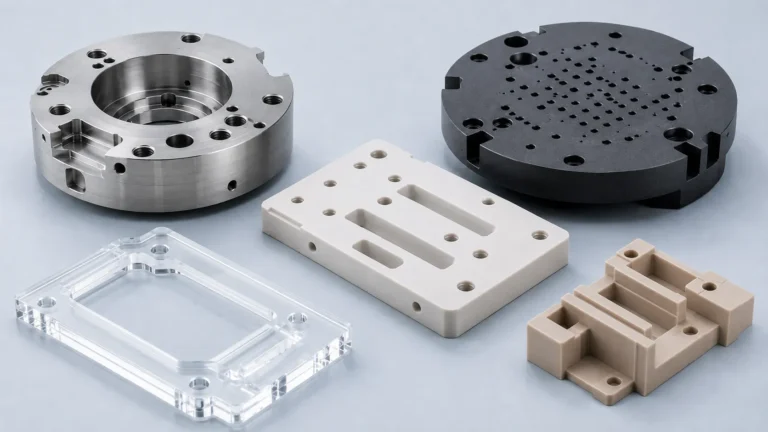
- Precision ceramic CNC machining
- Diamond grinding
- Precision hole machining
- Micro-hole machining
- Groove machining
- OD and profile grinding
- Thickness control
- Surface grinding
- Lapping
- Polishing
A semiconductor wafer heater may contain features such as:
- Lift pin holes
- Gas holes
- Sensor holes
- Alignment features
- Mounting structures
- Grooves
- Functional backside features
These features require control not only of dimensional tolerances but also of flatness, parallelism, surface roughness, hole position, edge quality, and microcracking.
Tool selection, machining parameters, fixture design, machining sequence, and material removal strategy therefore have a direct effect on final part quality.
A High-Performance AlN Heater Is More Than a 230 W/m·K Material
Thermal conductivity is an important performance parameter, but it is only one part of a successful ceramic heater design.
A high-performance AlN heater may also need to satisfy requirements for:
- Electrical insulation
- Ceramic density
- Mechanical strength
- Dimensional accuracy
- Flatness
- Parallelism
- Surface finish
- Thermal cycling reliability
- Heater-element integration
- High-temperature stability
When embedded heater elements are incorporated into the ceramic body, additional factors such as sintering shrinkage, thermal expansion compatibility, electrode integrity, and long-term high-temperature reliability must also be considered.
A high-performance AlN ceramic heater is therefore not simply a ceramic plate.
It is an integrated engineering product combining:
Material Engineering + Ceramic Forming + Sintering + Heater Design + Precision Machining + Thermal Management
Custom High Thermal Conductivity AlN Development and Machining
Different AlN applications require different combinations of thermal, electrical, mechanical, and dimensional properties.
For ceramic heaters, semiconductor equipment, power electronics, and high-power thermal-management components, thermal conductivity can be one of the most important design parameters.
We support custom AlN ceramic components by evaluating the required geometry, thermal performance, material properties, sintering requirements, and post-sintering machining processes.
Our previous development experience includes a custom AlN ceramic heater plate with thermal conductivity reaching 230 W/m·K, together with the associated ceramic manufacturing and precision-machining considerations.
For applications requiring high thermal conductivity, electrical insulation, tight dimensional control, and complex ceramic geometries, material selection and manufacturability should be considered from the earliest stages of product development.
From AlN powder and ceramic sintering to the final precision-machined heater plate, every manufacturing step can directly influence thermal performance, dimensional accuracy, and long-term reliability.
Engineering Note
The images and examples presented in this article are intended to illustrate common engineering concepts and representative industry practices. To protect customer confidentiality, certain dimensions, geometries, specifications, and application details may have been modified while preserving the underlying engineering principles.