
Precision Machining of a Threaded 99.6% Alumina Ceramic Gas Nozzle
High-purity technical ceramics are widely used in semiconductor, vacuum, plasma, and advanced processing equipment where conventional metals may not provide the required combination of electrical insulation, thermal stability, wear resistance, and chemical durability.
In this manufacturing case study, we produced a compact 99.6% alumina ceramic gas nozzle incorporating multiple angled micro-holes, an internal gas passage, a ceramic external thread, and several closely integrated precision features.
Although the component is relatively small, its geometry requires careful process planning and a thorough understanding of brittle ceramic machining.
More importantly, this project did not stop at prototype development. After process validation and optimization, the component was successfully transitioned into stable repeat production, demonstrating both manufacturing feasibility and production consistency.
What Is an Alumina Ceramic Gas Nozzle?
A ceramic gas nozzle is designed to introduce and distribute process gas through a controlled internal flow path.
Gas enters through the rear passage of the component and is directed through a series of precisely positioned outlet holes. The number of holes, hole diameter, orientation, and outlet angle can all influence the resulting gas distribution pattern.
Depending on the equipment design, ceramic gas nozzles and similar gas distribution components may be used in:
- Semiconductor processing equipment
- Plasma processing systems
- Vacuum chambers
- Gas delivery systems
- Thin-film processing equipment
- Surface treatment equipment
- Analytical instruments
- Laboratory and research systems
- High-temperature or electrically isolated gas systems
The actual application, gas type, flow rate, and distribution requirements vary depending on the equipment and process design.
Why Use 99.6% Alumina Ceramic?
Industrial gas nozzles can often be manufactured from stainless steel, aluminum, or other metallic materials. However, certain processing environments require additional material properties that engineering ceramics can provide.
99.6% alumina ceramic (Al₂O₃) offers a useful combination of:
- Excellent electrical insulation
- High hardness
- Good wear resistance
- High-temperature capability
- Good dimensional and thermal stability
- Strong chemical resistance in many environments
- Reduced risk of metallic contamination in sensitive applications
Because of these properties, high-purity alumina is commonly considered for components such as ceramic gas nozzles, electrical insulators, ceramic rings, spacers, guides, and other functional parts used inside advanced processing equipment.
For semiconductor, vacuum, and plasma-related systems in particular, material selection often involves more than mechanical strength alone. Electrical behavior, contamination control, chemical compatibility, and thermal performance may all influence the final design.
Manufacturing Case Study: 99.6% Alumina Ceramic Gas Nozzle
This component was manufactured from 99.6% high-purity alumina ceramic.
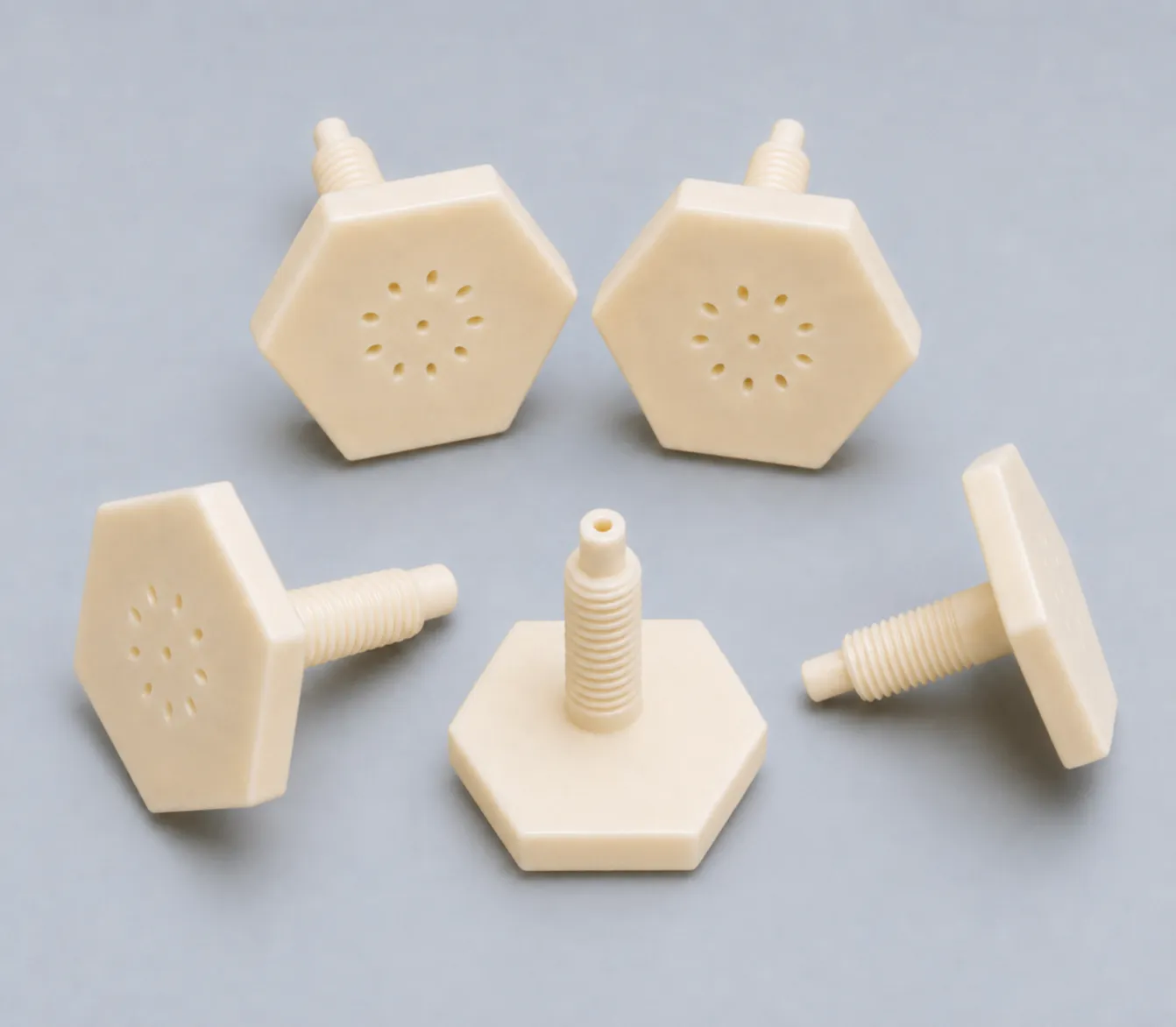
Its geometry incorporates a hexagonal external body, an internal gas passage, an external ceramic thread for installation, and a series of precision outlet holes.
One of the most important features is the outlet configuration:
8 equally distributed Ø0.7 mm micro-holes machined at approximately 50°.
Gas entering the internal passage can therefore be distributed outward through multiple angled outlets rather than discharged in a single direction.
From a manufacturing perspective, the primary consideration is not simply producing each individual feature. The challenge is maintaining the integrity and consistency of several delicate features within one compact brittle-ceramic component.
Key Manufacturing Consideration 1: Ø0.7 mm Ceramic Micro-Holes
Alumina is a high-hardness, low-ductility engineering ceramic. Its material removal behavior is significantly different from that of aluminum, stainless steel, or other metallic materials.
As hole diameter decreases, machining conditions become increasingly sensitive.
For the Ø0.7 mm micro-holes in this component, manufacturing control must consider more than the nominal hole diameter.
Important factors include:
- Hole diameter consistency
- Hole positional accuracy
- Entrance and exit edge integrity
- Local chipping control
- Hole wall condition
- Micro-crack risk
- Stability of the surrounding ceramic structure
For this reason, ceramic micro-hole machining is not simply a matter of creating a small opening.
The machining process must be selected and controlled according to the ceramic grade, hole size, depth, surrounding geometry, and required feature quality.
Experience with brittle materials becomes particularly important as feature sizes become smaller.
Key Manufacturing Consideration 2: 50° Angled Micro-Holes
The eight Ø0.7 mm holes are not perpendicular to the component surface.
Each hole is manufactured at an approximately 50° angle, creating an additional process consideration compared with conventional straight-hole machining.
During angled machining, the tool initially contacts the ceramic surface asymmetrically. This can generate localized loading at the entry point, making process stability and edge control particularly important.
For a brittle material such as alumina, the machining strategy must therefore consider:
- Stable tool engagement
- Entry-edge integrity
- Angled-hole positioning
- Machining reference control
- Consistency between multiple holes
The smaller the hole diameter, the more sensitive the process becomes to these factors.
Key Manufacturing Consideration 3: Multi-Hole Positional and Angular Consistency
For a multi-hole gas distribution component, producing one acceptable hole is only part of the requirement.
All eight outlets must maintain their intended relationship to one another.
This requires control of:
- Relative hole positions
- Hole spacing
- Hole diameter
- Outlet direction
- Machining angle
- Common machining datum
- Repeatability between parts
These relationships can influence the geometry of the gas distribution pattern.
Therefore, multi-hole ceramic gas nozzles require both individual feature control and consistent geometric relationships across the entire hole pattern.
This is one reason why process planning is especially important for components containing several closely spaced micro-features.
Key Manufacturing Consideration 4: M5 Ceramic External Thread
Another important feature of this component is its M5 external ceramic thread.
Thread machining in alumina requires a different approach from conventional metal threading.
Metallic materials generally provide a certain degree of plastic deformation during machining and assembly. Alumina ceramic does not offer the same behavior.
Local stress therefore needs to be carefully controlled to preserve thread integrity.
Key areas requiring attention include:
- Thread profile accuracy
- Thread crest integrity
- Thread root condition
- Local chipping control
- Transition between the thread and component body
- Assembly fit
When a ceramic thread is positioned close to internal passages, thin walls, or other precision features, the manufacturing process must consider the component as an integrated structure rather than treating the thread as an isolated feature.
Key Manufacturing Consideration 5: Multiple Precision Features in a Compact Ceramic Part
The complexity of a precision ceramic component is not determined by its overall dimensions alone.
This gas nozzle is relatively compact, but it combines:
- Micro-holes
- Angled holes
- Internal gas passages
- External ceramic threads
- Radiused transitions
- Local thin-wall sections
When several brittle-material features are concentrated within a small area, machining sequence and workholding strategy become increasingly important.
Before manufacturing, it is necessary to consider questions such as:
- Which features should be machined first?
- Which datum should be used for subsequent operations?
- How should the component be supported during machining?
- How can clamping forces be kept away from vulnerable areas?
- How can previously completed features be protected during later operations?
- How can positional relationships be maintained across multiple setups?
For complex technical ceramics, process planning can be just as important as the machining equipment itself.
Key Manufacturing Consideration 6: Edge Integrity and Chipping Control
High hardness is one of alumina ceramic’s greatest advantages, but alumina behaves differently from ductile metals when subjected to localized machining stress.
Particular attention is required around:
- Micro-hole entrances and exits
- Thread crests
- Thin-wall transitions
- Sharp geometric transitions
- External edges
Improper machining conditions can result in localized edge damage or chipping.
For this reason, machining parameters, tooling, feature sequence, and edge-treatment strategy need to be adapted to the geometry of each area rather than applying one machining condition to the entire part.
This approach helps maintain feature integrity and improve part-to-part consistency.
From Prototype Development to Stable Production
Producing a successful prototype is only the first stage of developing a reliable ceramic manufacturing process.
For production applications, the more important question is whether the process can be made repeatable, controllable, and consistent across multiple parts and production batches.
This project progressed beyond prototype machining.
Following process development, manufacturing validation, and parameter optimization, we established a stable manufacturing process for this 99.6% alumina ceramic gas nozzle, and the component has since moved into stable repeat production.
During this transition, manufacturing control focused not only on dimensional compliance but also on:
- Micro-hole consistency
- Angled-hole position and orientation
- Edge integrity
- Ceramic thread quality
- Part-to-part consistency
- Batch-to-batch repeatability
- Chipping and breakage control
- Cleaning and packaging consistency
Through actual production experience, the machining sequence, fixturing approach, tooling conditions, and process parameters were progressively optimized to provide a reliable and repeatable manufacturing workflow.
This project demonstrates our capability not only in prototype ceramic machining, but also in transferring validated processes into repeat and volume production.
For ceramic components used in semiconductor, vacuum, plasma, and other advanced equipment, this transition from prototype feasibility to stable manufacturing is an important part of long-term supply reliability.
Inspection, Cleaning, and Vacuum Packaging
For semiconductor, vacuum, and other high-end equipment components, machining is often only one part of the overall manufacturing process.
Following precision machining and inspection, this component also requires cleaning and controlled packaging.
The finished parts are packaged using double-layer transparent plastic bags with vacuum sealing to reduce exposure to external contamination during handling, storage, and transportation.
A typical supply workflow for this type of component may therefore include:
Material Selection → Precision Machining → Inspection → Cleaning → Vacuum Packaging
For components intended for vacuum systems or contamination-sensitive environments, post-machining handling and packaging should be considered part of the overall manufacturing process rather than an afterthought.
Precision Ceramic Machining Is More Than Achieving Dimensions
For complex technical ceramic parts, successful manufacturing requires more than meeting isolated dimensional tolerances.
Material properties, geometry, machining datum, workholding, feature sequence, edge integrity, and inspection strategy all need to be considered together.
In this alumina gas nozzle, the Ø0.7 mm micro-holes, 50° angled outlets, M5 ceramic thread, and internal gas passage are geometrically different features, but they interact with one another during manufacturing.
The ability to understand these interactions and build an appropriate process around them is a critical part of precision ceramic machining expertise.
Potential Applications of Alumina Ceramic Gas Nozzles
Based on their material properties and gas-distribution geometry, custom alumina ceramic gas nozzles and related components may be considered for:
- Semiconductor processing equipment
- Plasma processing equipment
- Vacuum systems
- Gas delivery systems
- Thin-film processing equipment
- Analytical instruments
- Laboratory and research equipment
- Electrically insulated gas systems
- High-temperature gas-handling equipment
Depending on the application, the design can be customized in terms of:
- Hole diameter
- Number of holes
- Outlet angle
- Hole pattern
- Internal flow-path geometry
- Thread specification
- Alumina purity
- Overall dimensions
These components are therefore commonly manufactured as custom precision ceramic parts based on customer drawings or 3D CAD models, rather than as standardized off-the-shelf nozzles.
Precision Technical Ceramic Manufacturing Capabilities
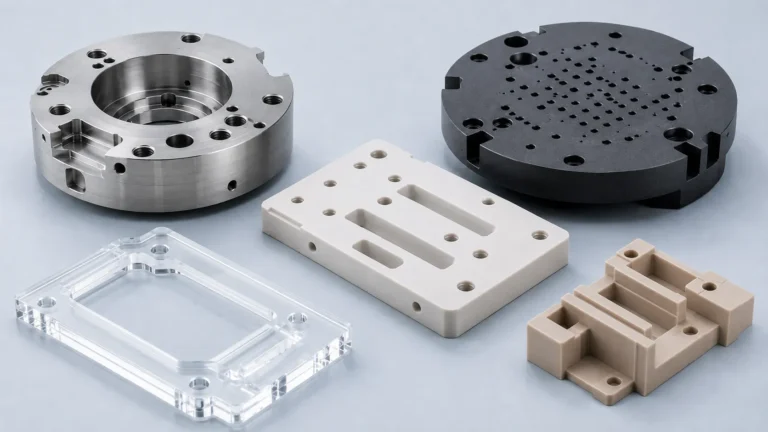
In addition to 99.6% alumina ceramic, advanced semiconductor, vacuum, optical, and industrial systems may require components manufactured from a variety of hard and brittle materials, including:
- Alumina
- Zirconia
- Aluminum Nitride (AlN)
- Silicon Carbide (SiC)
- Macor machinable glass ceramic
- Quartz
- Sapphire
Each material behaves differently in terms of hardness, fracture behavior, thermal conductivity, electrical properties, and chemical stability.
As a result, machining methods and process strategies must be selected according to both the material and the component geometry.
We have practical experience supporting technical ceramic and hard-brittle material projects from manufacturing feasibility evaluation and prototype development through stable repeat production.
Features we can evaluate include:
- Micro-holes
- Angled holes
- Ceramic threads
- Thin-wall structures
- Internal features
- Precision profiles
- Complex geometries
For R&D prototypes, specialized ceramic components, or repeat-production requirements, customers can provide a 2D drawing or 3D CAD model for manufacturing feasibility and process evaluation.
Engineering Note
The images and examples presented in this article are intended to illustrate common engineering concepts and representative industry practices. To protect customer confidentiality, certain dimensions, geometries, specifications, and application details may have been modified while preserving the underlying engineering principles.